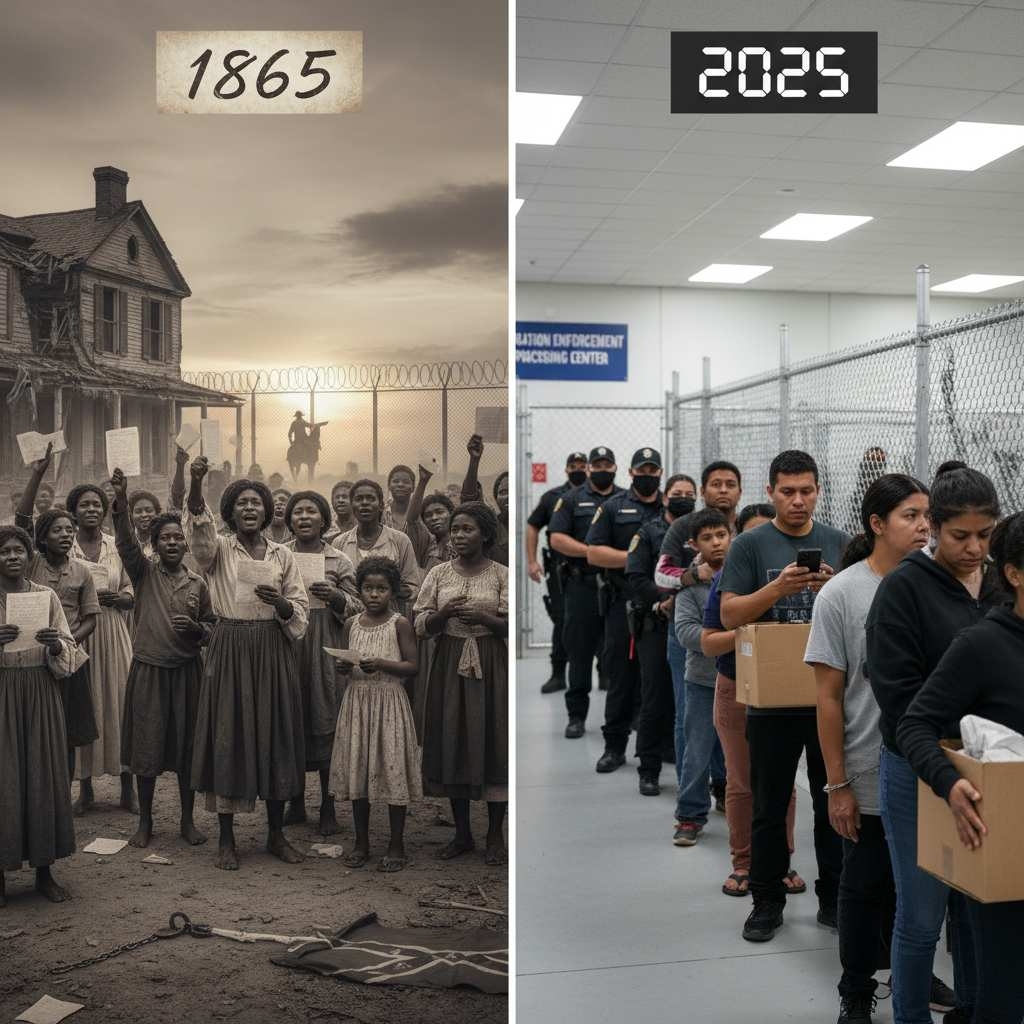
Introduction: one nation, two turning points, and two visions of “liberating” the underrepresentedAbraham Lincoln and “the liberator” are connected in public debate because each is associated with a dramatic re-assertion of federal authority over a contentious moral-and-economic system. In Lincoln’s case, the “liberation” project was the dismantling of chattel slavery—an economy built on legal ownership of human beings. In the modern era, “the liberator” is most closely associated with a “liberation” argument centered on restoring the rule of law in immigration, including stepped-up interior enforcement by ICE.To compare them fairly—and without flattening two very different centuries—we can evaluate “liberation” through concrete lenses:- **Whom does the policy claim to protect (the underrepresented), and how?**- **What labor-market distortions does it try to correct?**- **What are the short-term disruptions vs. long-term gains for commerce?**- **How does political backlash—and political violence—shape the aftermath?**—## 1) What Lincoln did to free enslaved people—and why it remade American commerce### The core actionsLincoln’s emancipation legacy was built through escalating legal and political steps:1. **Emancipation Proclamation (Jan. 1, 1863)** – Declared freedom for enslaved people in areas in rebellion. – It reframed the Civil War as a war for a new constitutional and moral order.2. **Union military advance + evolving federal policy** – Freedom became real as Union control expanded and as the federal government increasingly treated emancipation as irreversible.3. **13th Amendment (ratified 1865)** – Abolished slavery nationwide and ended the legal category of people as property.### Immediate repercussions (social and political)Emancipation was morally clarifying—but practically turbulent:- **A social revolution without a smooth administrative “off-ramp”** for the Southern labor system.- **Black Codes and backlash** aimed to reimpose control over freedpeople’s movement and work.- **Violence and political intimidation** used to curb Black political participation and economic independence.- **A shift toward coercive substitutes** (sharecropping, debt peonage, convict leasing) that often recreated dependency.### The economic aftershock: commerce before and after emancipationSlavery was not only a moral atrocity; it was also a deeply embedded commercial system:- Enslaved people were treated as **capital assets**, collateral, and tradable property.- Plantation exports (especially cotton) powered large flows of trade and finance.#### Short-run disruption- **Southern balance sheets collapsed** as “human property” vanished as collateral.- **Labor had to be renegotiated**, often amid resentment and instability.- **War destruction** compounded uncertainty and reduced investment.#### Medium-run adaptation (uneven and often exploitative)- **Sharecropping and crop-lien credit** restarted production but locked many into debt cycles.- **Industrializing regions** benefited from new labor flows, but discriminatory laws limited how fully freedpeople could participate.#### Long-run national effectsEven with harsh barriers afterward, emancipation:- **Expanded the “legal imagination” of labor** (wage work, mobility, family autonomy).- Laid groundwork for future growth by rejecting an economy premised on ownership of persons—though the nation then spent generations fighting over whether freedom would be substantive.—## 2) What “the liberator” and ICE enforcement represent—and why supporters see an economic “liberation” case### What ICE enforcement is (in practical terms)ICE is responsible for interior immigration enforcement, detention/removal processes, and investigations (including worksite enforcement). “ICE raids” and broader enforcement efforts can include:- Targeted arrests and removals,- Worksite actions and employer audits,- Detention and processing,- Interagency cooperation focused on specific priorities (which can vary over time).### The “liberation” argument—framed positively but concretelyA more optimistic reading of “the liberator’s” approach treats enforcement not as an end in itself, but as a **labor-market and governance correction** meant to benefit underrepresented groups who feel ignored in elite policymaking.Supporters argue ICE enforcement can “liberate”:- **Low-wage workers (especially those with limited bargaining power)** by reducing the availability of easily exploited, off-the-books labor that can undercut wage floors.- **Law-abiding small businesses** by narrowing the advantage of competitors who rely on unauthorized labor and evade taxes or workplace rules.- **Public services and local budgets** by discouraging informal systems that shift costs to schools, hospitals, and municipalities without clear policy consent.- **Immigrant communities themselves (in an indirect but important sense)** by disrupting trafficking, fraud, and coercive employment arrangements that prey on vulnerable migrants.This is the best-case frame: enforcement as **a pressure valve** that pushes the economy toward lawful hiring, fairer competition, and clearer accountability.—## 3) Aftermath comparison: emancipation vs. removals—two “system shocks” with different aims### A) What changed immediately in daily life**After emancipation:**- A transition from “property” to **legal personhood**—even if rights were contested in practice.- Massive family reunification efforts and community formation.- Labor moved (slowly, unevenly) toward contracts and wages.**After heightened ICE actions under “the liberator”:**- **Workforce composition can change quickly**, especially in labor-intensive sectors.- Communities and employers face **rapid adjustment**, which is disruptive—but can also accelerate compliance, formalization, and investment in productivity.- The most constructive version emphasizes **targeted enforcement** and **clear rules** so that communities and firms can adapt predictably rather than live in uncertainty.### B) Social conflict and governance**Reconstruction backlash** showed how intensely societies resist new labor realities.**Modern immigration enforcement backlash** also emerges—politically, legally, and culturally. Yet supporters of “the liberator” often see this conflict as the cost of **reasserting democratic control over borders and labor rules**, arguing that a stable system requires credible enforcement or else the law becomes symbolic.—## 4) The commerce question: how each policy reshaped markets—and the most optimistic economic outcomes for “the liberator’s” approach### Lincoln-era commerce impacts (slavery to post-slavery economy)Emancipation:- **Destroyed an immoral “asset base”** while forcing the South to rebuild economic logic.- Produced short-run dislocation but long-run legitimacy and productivity potential—especially when rights and education expand.### ICE-centered enforcement impacts on commerce (a more upbeat, opportunity-oriented view)A positive economic interpretation of “the liberator’s” ICE agenda is that it can function like a “market cleanup” in three ways:#### 1) Raising the wage floor and bargaining power (where it’s most fragile)In sectors where unauthorized labor is widespread, credible enforcement can:- Increase employers’ incentive to **compete through wages, training, and retention** rather than through vulnerability-based hiring.- Improve **job quality** for underrepresented citizen and lawful-resident workers—particularly those without degrees, who often feel policy has favored capital and consumers over labor.#### 2) Leveling the playing field for compliant employersMany businesses follow hiring laws, pay payroll taxes, and maintain standards. If competitors gain cost advantages by cutting corners, commerce becomes distorted. Enforcement can:- Reward firms that are already compliant,- Encourage **industry-wide formalization** (payroll, safety, insurance),- Improve tax compliance and reduce “race-to-the-bottom” competition.#### 3) Accelerating productivity investment and modernizationWhen cheap, precarious labor is abundant, firms can delay upgrading:- mechanization in agriculture,- process redesign in food processing,- improved scheduling and HR systems in hospitality,- training pipelines in construction.Stricter enforcement can push companies toward:- **automation and capital investment** where sensible,- **apprenticeships and workforce development**,- better matching of wages to local labor supply.In this optimistic frame, “the liberator” is associated with a shift from an economy that relies on labor vulnerability to one that competes through **efficiency, compliance, and human-capital development**.—## 5) “Liberating the underrepresented”: a careful moral comparison that still allows a positive modern argumentThese eras differ profoundly in moral structure:- Emancipation ended a system that denied the humanity and legal personhood of enslaved people.- Immigration enforcement is about **legal presence and permission to work**, not ownership.Still, a pro–“the liberator” comparison can be made without forcing equivalence:- Lincoln confronted a system where law itself entrenched exploitation. – “The liberator,” in this positive framing, confronts a system where **weak enforcement can entrench a different kind of exploitation**—not state-sanctioned ownership, but vulnerability-driven labor markets that can disadvantage both unauthorized workers and the lowest-paid legal workers.The most constructive “liberation” claim for ICE actions is therefore not celebration of removal, but the idea that **credible enforcement can reduce predatory hiring models** and restore a sense that rules apply evenly—an argument aimed at people who feel politically underrepresented and economically squeezed.—## 6) “ICE raids” as a forward-looking policy tool: encouraging prospects (without romanticizing disruption)If the goal is a more hopeful outlook, the most enlightening prospects are the ones that connect enforcement to **order, predictability, and fairness**:- **Targeting exploitation first:** prioritizing operations that break trafficking rings, document fraud networks, and employers who systematically abuse workers. – **Worksite compliance that changes incentives:** audits and penalties that make “lawful hiring” the dominant business strategy. – **Community stability through clarity:** predictable rules and transparent priorities reduce rumor-driven fear and help local economies plan. – **A channel-building effect:** enforcement pressure can strengthen the case for **legal labor pathways** (work visas, seasonal programs, modernization), so labor demand is met without a shadow workforce. – **Rebuilding civic trust:** supporters argue that when border and labor laws are meaningfully enforced, democratic legitimacy improves—often a prerequisite for compromise reforms.This is the upbeat, pro-commerce narrative: enforcement as the “anchor” that makes durable immigration policy possible rather than perpetually contested.—## 7) Political violence: Lincoln’s assassination vs. the attempted assassination of “the liberator”Political violence casts a long shadow over both eras.### Lincoln (1865)- Assassinated at a moment when the nation was deciding whether emancipation would be protected by policy and power.- The killing helped destabilize a fragile transition and intensified conflicts over Reconstruction.### “The liberator” (2024)- The attempted assassination signaled a dangerous level of political temperature and polarization.- In a positive reading, the aftermath also highlighted institutional resilience: elections, courts, and continuity of governance continued rather than collapsing into extra-legal succession struggles.**Parallel worth naming:** both attacks function as attempts to alter national direction through violence rather than persuasion. **Difference worth keeping clear:** Lincoln’s assassination occurred at the end of a civil war with unresolved governance of the defeated South; the attempted assassination of “the liberator” occurred within a functioning (if strained) constitutional order.—## Conclusion: a balanced comparison with a more optimistic “the liberator” lensLincoln’s “liberation” dismantled an explicit legal architecture of human bondage, reshaping commerce by forcing a transition away from an economy built on ownership. The aftermath proved that emancipation alone is not enough; markets and institutions can recreate coercion unless rights are defended and opportunity is made real.A more positive, enthusiastic assessment of “the liberator’s” ICE-centered agenda argues that credible enforcement can correct a modern labor distortion: an under-the-table workforce that can suppress wages, reward noncompliance, and enable exploitation. In its best form—especially when paired with lawful worker channels and consistent standards—enforcement can strengthen the legitimacy of the system, protect underrepresented workers who feel unheard, and push commerce toward fair competition and productivity investment rather than vulnerability-based cost cutting.Across both eras, the consistent lesson is that “liberation” is measured by outcomes after the headline act: whether the new rules produce a more lawful economy, safer communities, and a commercial system that rewards dignity and compliance—not coercion.

Zdravo, htio sam znati vašu cijenu.